
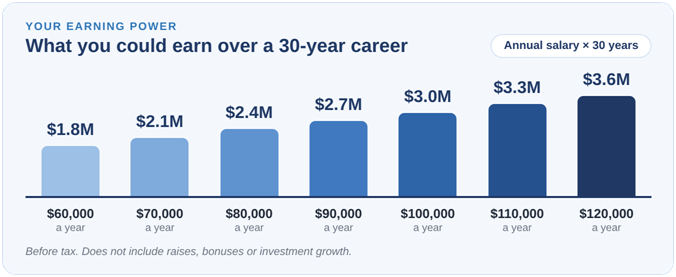
Most of us insure our homes, our cars and our lives without a second thought. Yet the thing that pays for all of them, our ability to earn an income, often goes unprotected. Over a 30-year career, even a modest salary adds up to millions of dollars.
Disability is also more common than many people think. In 2022, Statistics Canada found that 27% of Canadians aged 15 and older, about 8 million people, had a disability that limited their daily activities, and 39% of them reported a mental health-related disability.1 It is often an illness, not an accident, that keeps someone off work.
How Disability Insurance Works
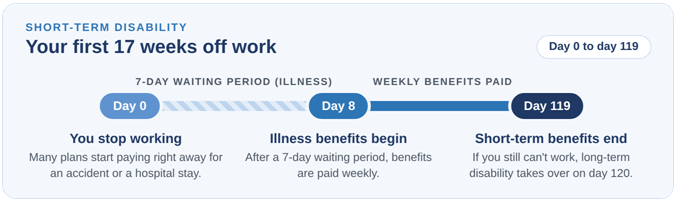
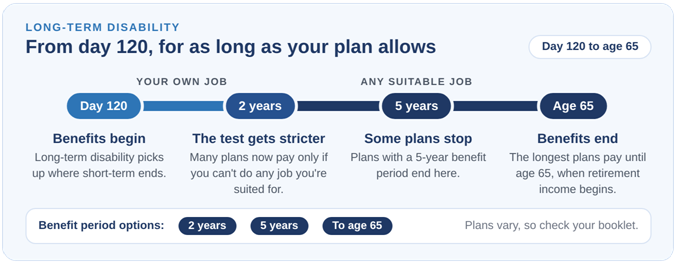
Disability insurance pays you a monthly benefit if an illness or injury keeps you from working, so you can keep up with your mortgage or rent and everyday bills while you recover. Through work, it usually comes in two parts designed to work together: short-term disability for the first few months, and long-term disability if you are off longer. You can also buy an individual policy you own, which stays with you wherever you work.2
Here is How a Typical Workplace Plan Works:
What Would Actually Replace Your Income?
Many people assume government programs will step in. They can help, but they are limited and were never designed to replace a full paycheque.
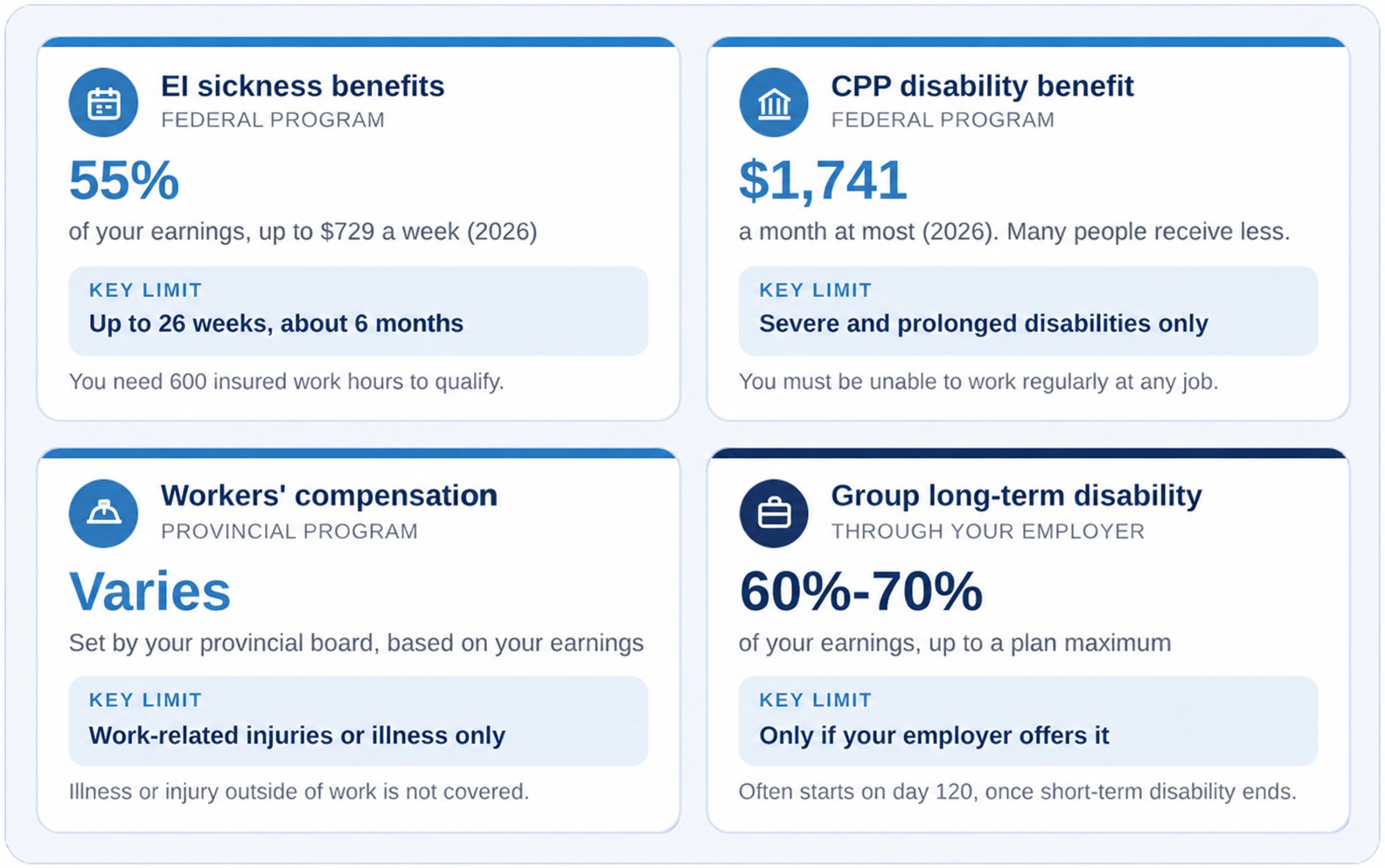
Consider a hypothetical 40-year-old earning $70,000 a year, about $5,830 a month before tax. If they had no disability coverage through work and their condition did not qualify for CPP, EI sickness benefits would pay at most about $3,160 a month, and only for six months. 4 After that, their income would stop entirely.
Where Workplace Coverage Can Fall Short
- Not everyone has it. Many small businesses do not offer long-term disability, and self-employed and contract workers usually have no group coverage at all. 8
- It only replaces part of your income. Plans often pay 60% to 70% of earnings up to a monthly maximum, so higher earners may be capped well below that. 3
- The definition of disability can change. As the long-term disability timeline shows, many plans pay if you cannot do your own job for the first two years, then only if you cannot do any job you are reasonably suited for. 3
- Other benefits are deducted. Long-term disability payments are usually reduced by what you receive from CPP disability, workers' compensation or other sources. 3
- It ends when your job does. If you leave, are laid off or your employer changes the plan, coverage typically stops, and there is often little or no option to take it with you. 2
Protecting Your Income
A strong plan starts with knowing what you already have. An emergency fund can carry you through waiting periods, and an individual disability policy can fill the gaps a workplace plan leaves, or cover you if you are self-employed. It stays with you wherever you work2, and benefits are generally tax-free. 3 Critical illness insurance, which pays a lump sum if you are diagnosed with a covered condition such as cancer, a heart attack or a stroke, can be a helpful complement.
Is Your Income Protected?
Wescan Insurance Brokers can review your workplace disability coverage, show you where the gaps are and compare individual options from multiple insurers side by side. Reach out to start the conversation.
wescaninsurance.ca | info@wescaninsurance.ca
Unit 115, 1925 18 Ave NE, Calgary, AB T2E 7T8
Sources
- Statistics Canada. "Canadian Survey on Disability, 2017 to 2022." The Daily, December 1, 2023. https://www150.statcan.gc.ca/n1/daily-quotidien/231201/dq231201b-eng.htm
- Canada Life. "Disability insurance" (group vs. individual coverage). https://www.canadalife.com/insurance/disability-insurance.html
- Financial Consumer Agency of Canada. "Disability insurance." Government of Canada, updated July 31, 2026. https://www.canada.ca/en/financial-consumer-agency/services/insurance/disability.htm
- Service Canada. "EI sickness benefit: How much you could receive." Government of Canada, 2026. https://www.canada.ca/en/services/benefits/ei/ei-sickness/benefit-amount.html
- Service Canada. "Canada Pension Plan: Pensions and benefits monthly amounts." Government of Canada, 2026. https://www.canada.ca/en/services/benefits/publicpensions/cpp/payment-amounts.html
- Employment and Social Development Canada. "About the Canada Pension Plan disability benefits." Government of Canada. https://www.canada.ca/en/employment-social-development/programs/pension-plan-disability-benefits.html
- Association of Workers' Compensation Boards of Canada. "Workers' Compensation Essentials." https://awcbc.org/about-us/our-members/workers-compensation-essentials
- Meredith, T. and Chia, C. "Leaving Some Behind: What Happens When Workers Get Sick." Institute for Research on Public Policy, September 2015. https://irpp.org/research-studies/leaving-some-behind-what-happens-when-workers-get-sick/