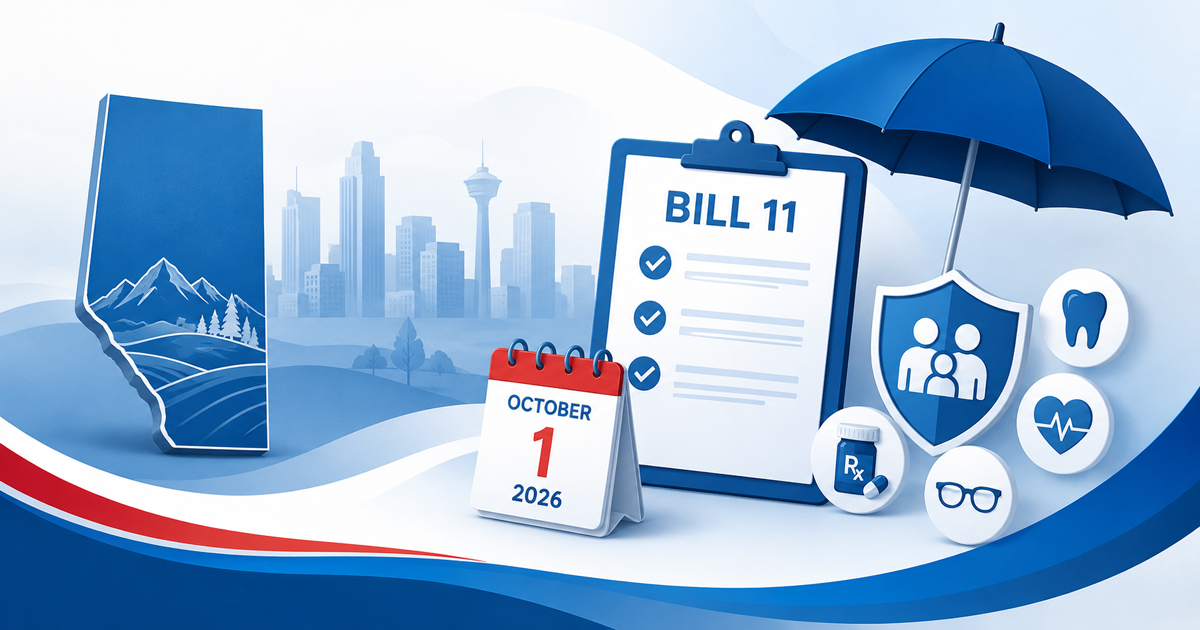
1. Does Bill 11 Apply to You?
This change comes from Alberta's Health Statutes Amendment Act, known as Bill 11. It's provincial legislation, so it applies to employees who live in Alberta. If you live in British Columbia, Saskatchewan, or anywhere else in Canada, this particular change doesn't affect your coverage, even if your employer's head office is in Calgary or Edmonton. Your province of residence is what matters, not your company's address.
For Alberta residents, the new coordination rules apply specifically if you are simultaneously enrolled in an employer plan and one of the following provincial health programs:
- Coverage for Seniors: Automatic, premium-free supplemental coverage provided by the Alberta government for residents aged 65 and older.
- Non-Group Coverage: Optional, individual supplemental coverage available to Albertans under age 65, paid via a monthly personal premium.
Important Rule for Single-Plan Members: If you only have workplace benefits and are not enrolled in either provincial program, Bill 11 creates zero change in how your pharmacy or extended health claims are adjudicated.
2. The Two Core Pillars of Bill 11
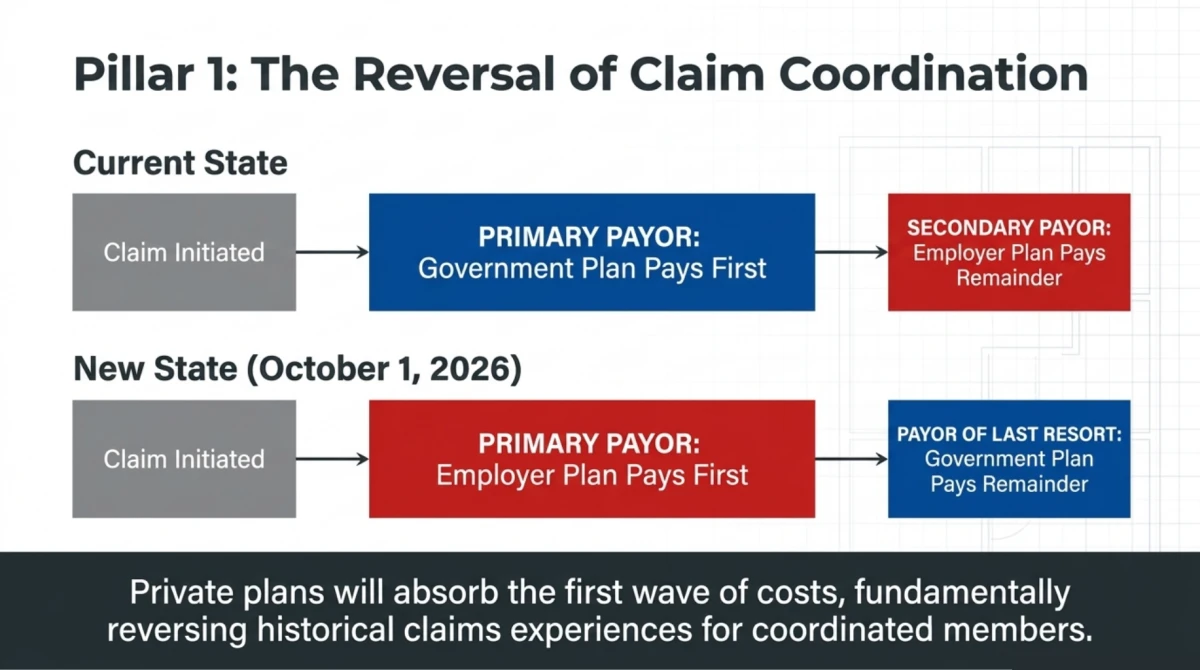
Pillar 1: Reversal of Claim Coordination (Payor of Last Resort)
Historically in Alberta, when an employee coordinated coverage between a workplace plan and a government program, the provincial plan acted as the primary payor on eligible expenses, with the employer plan picking up leftover coinsurance amounts.
Starting October 1, 2026, this sequence reverses completely. The Government of Alberta becomes the payor of last resort. Under the new rules:
- The employer group plan pays FIRST on all submitted eligible expenses.
- The provincial government program pays LAST, covering only the eligible remainder within provincial formulary and benefit rules.
Pillar 2: Mandatory Coverage Protection for Active Staff 65+
The second major component of Bill 11 establishes statutory protection for older workers. Effective October 1, 2026, Alberta employers are prohibited from terminating or reducing prescription drug and select extended health benefits based on age for any employee who remains actively employed.
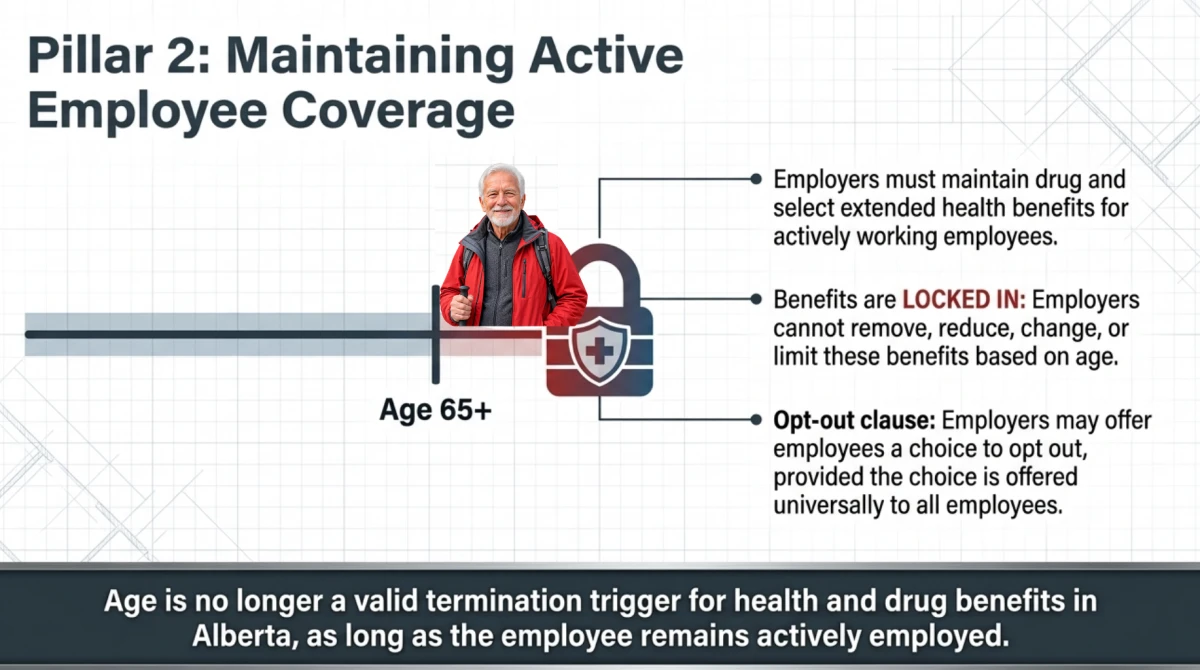
If your coverage was already cut off, you get it back. Employees removed from a plan at a set age but still actively working must be added back on. If this happened to you, you don't need to negotiate for it - the legislation requires it.
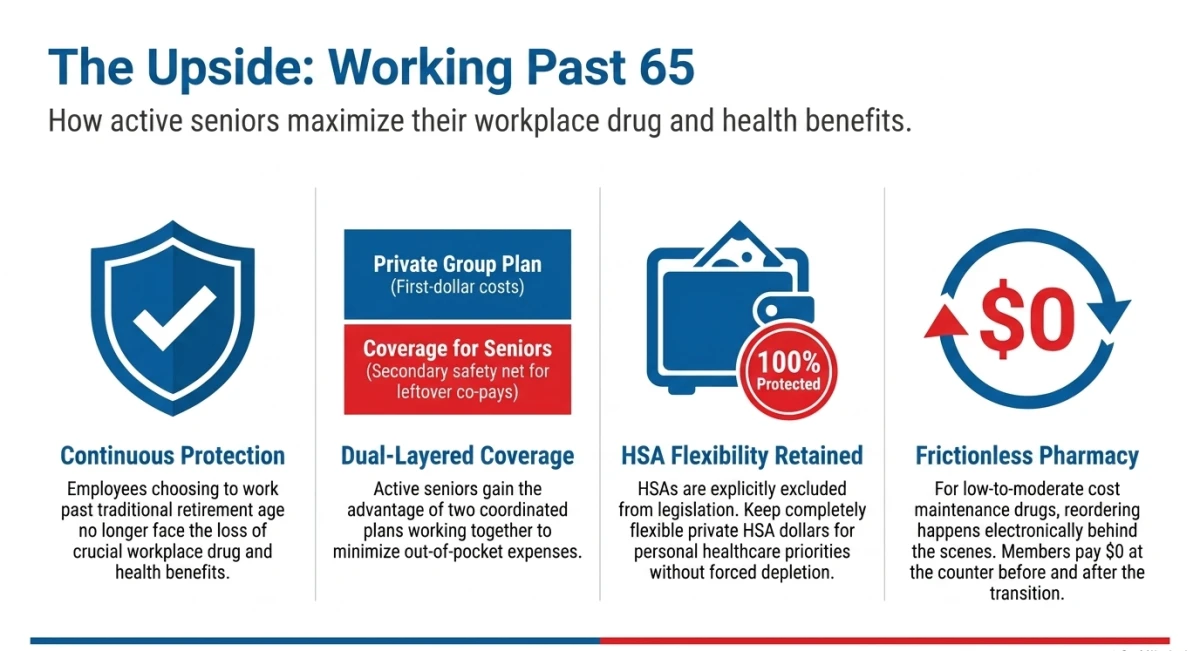
- Guaranteed Protection Past 65: Employees choosing to work past traditional retirement age no longer face the loss of crucial workplace drug and health benefits.
- Stacked Coverage Value: Active seniors gain the advantage of two coordinated plans. The private group plan covers first-dollar costs, while Coverage for Seniors provides a secondary safety net for leftover co-pays.
- Health Spending Accounts (HSAs) Are Protected: HSAs are explicitly excluded from the legislation. Plan members are not required to deplete private HSA dollars before accessing provincial support. These funds remain completely flexible for the employee's personal healthcare priorities.
- Seamless Pharmacy Experience for Maintenance Drugs: For low-to-moderate cost medications, the entire reordering takes place electronically behind the scenes. Members pay $0 at the counter before and after the transition.
The Downside
1. High-Cost Specialty Drug
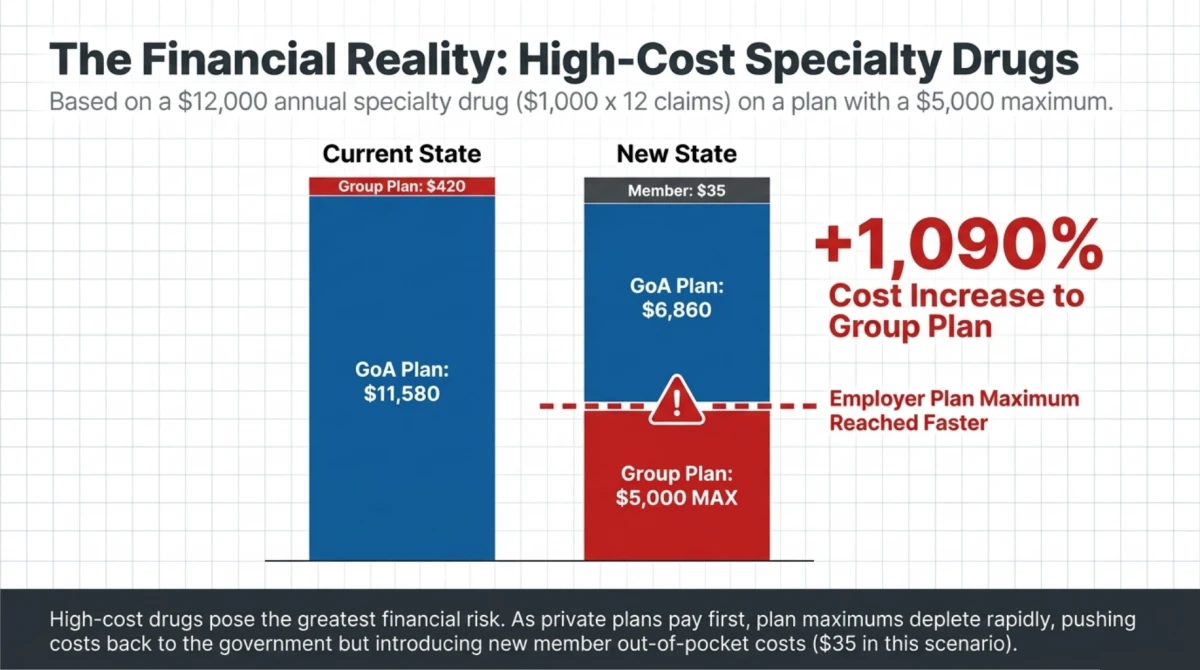
You may hit your annual plan maximum earlier in the year. Because your workplace plan now pays first, it gets used up faster. If your drug coverage has an annual cap, you may reach it partway through the year instead of never reaching it at all.
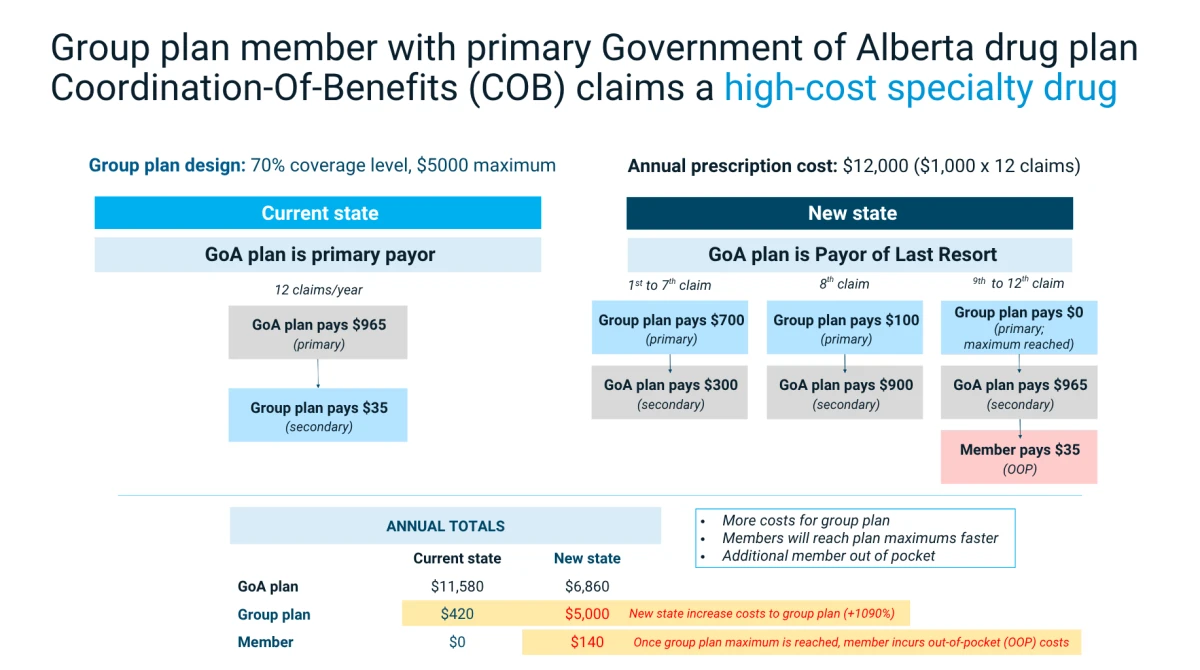
Once you hit that maximum, some costs become yours. This is the real risk in the legislation, and it lands hardest on people taking high-cost specialty medications on plans with low annual drug maximums.
A realistic illustration: a member taking a $1,000-a-month medication, workplace plan covering 70% with a $5,000 annual drug maximum. Today that person pays nothing all year. After October 1, they'd exhaust the workplace plan maximum around the eighth month and pay roughly $35 per fill for the rest of the year — about $140 over the year. Not catastrophic in this example, but on a plan with a lower cap or a more expensive drug, the figure gets larger.
The government’s covered drug list is more limited than most workplace plans. Alberta’s provincial programs cover roughly 6,000 drug identification numbers, while many private plans cover a wider range. This means that for some medications, your workplace plan may now be the first-and only plan that pays.
There could also be a longer-term impact on workplace benefit costs. As employer plans take on a larger share of claims, insurers estimate that combined drug and health claims could rise by roughly 2% to 5%. Over time, employers may respond through higher premiums, increased employee contributions, or changes to benefit plans at renewal. This will not happen immediately, and the impact will vary significantly from one employer to another, but it is an important longer-term consideration.
Retirees on a former employer's retiree plan face the sharpest version of this, since a higher share of retired members are enrolled in Coverage for Seniors.
2. Low-Cost Traditional Drug
If you take ordinary maintenance medication, you'll pay the same at the pharmacy counter as you do today. The reshuffling happens between the two plans, invisibly.
Here's what that looks like in practice. Meet a plan member who takes a $50 medication, filled four times a year — $200 for the year. Her workplace plan covers 70%, and she also has coverage through an Alberta government drug plan.
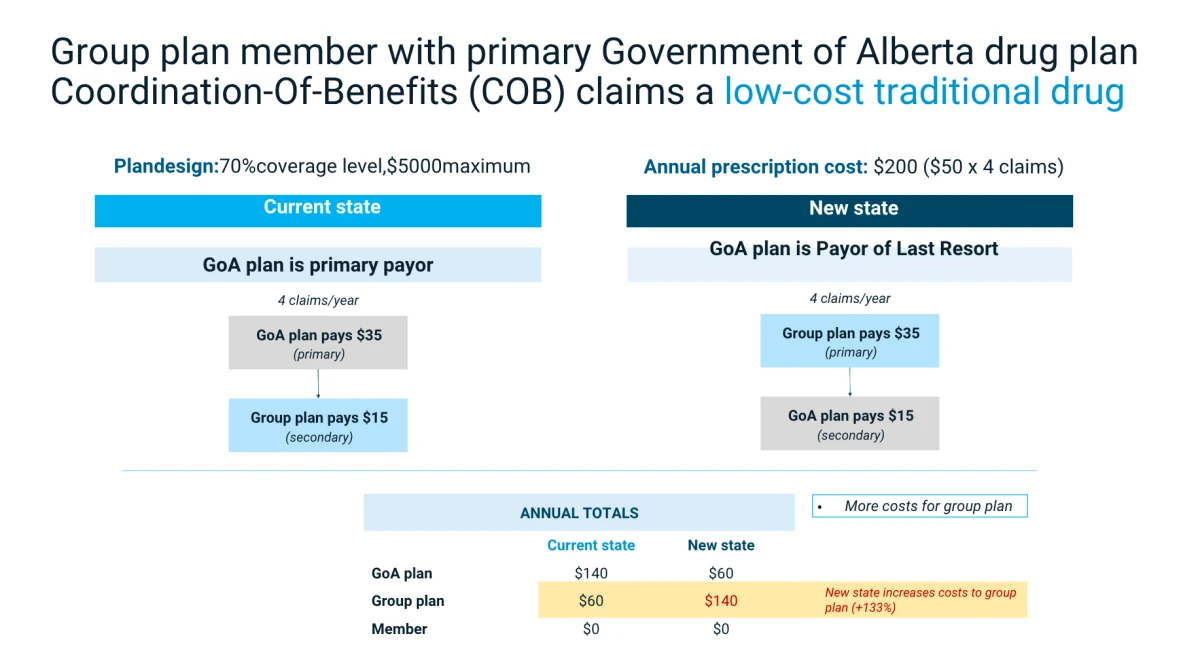
Today, the government plan pays first. It covers $35 of each $50 fill, and her workplace plan covers the remaining $15. From October 1, that order reverses: her workplace plan pays $35 and the government plan picks up the last $15.
Over the full year:
- Government plan: $140 today → $60 after October 1st 2026
- Workplace plan: $60 today → $140 after October 1st 2026
- Her own cost: $0 today → $0 after October 1st 2026
The amounts never change — whoever pays first covers $35, whoever pays second covers $15. Only the order swaps. Her employer's plan ends up carrying more of the cost, but she pays nothing at the pharmacy either way.
Three Things to do Before 1st October 2026 for Employees:
- Find out if you're coordinating two plans. If you're 65 or older in Alberta, you're likely enrolled in Coverage for Seniors automatically. If you're under 65 and paying a monthly premium for Non-Group Coverage, you're coordinating too.
- Check your annual drug maximum. It's in your benefits booklet or your member portal. If you take expensive ongoing medication, this number matters most.
- Ask about age-based termination. If you're working past 65, or approaching it, confirm with HR that your coverage continues. If it was already cut off while you were still working, ask to be reinstated.
Three Things to do Before 1st October 2026 for Employers:
- Review your plan design for savings opportunities. Before you accept a rate increase, look at whether the plan itself can be adjusted - formulary options, generic substitution, dispensing fee caps, or maintenance medication programs. Some of the added cost from Bill 11 can be offset here rather than passed through in premium.
- Prepare for premium adjustments and rate action. Expect the coordination shift to show up at your next renewal. Know your plan demographics before that meeting - how many of your members are 65 or older, and how many are likely enrolled in a government program - because that number determines how much Bill 11 costs your plan.
- Consider pooling. Pooling helps with infrequent, high-cost claims, so it's worth reviewing. However, it won't address the broad redistribution of costs from government programs to your plan, which is the bulk of the impact.
Questions About Your Specific Coverage
If you have any further questions about Health Spending Accounts, please don’t hesitate to contact us.
You may be interested in

How to Choose the Best Health Insurance Broker in Alberta for Your Business
Choosing a health insurance broker shapes how your employees experience your bus...

How A Health Spending Account (HSA) Works
A HSA (Health Spending Account) is a tax-effective benefit funded by the employe...

Understanding Wellness Spending Accounts: How WSAs Work in Canada
A Wellness Spending Account (WSA) offers Canadian employers a straightforward wa...